How to play rummy — a deal-to-declaration walkthrough.
A practical reader's walkthrough of 13-card Indian rummy: from the deal to a valid declaration, with common mistakes.
Before the deal
A few minutes of setup save hours of argument.
Before the first deal, agree on five things. They sound pedantic; they prevent nearly every dispute we see in 13-card play.
Step 01 · The deal
Thirteen cards each, one face-up, the rest face-down.
The dealer deals 13 cards to every player, face down. The next card from the stock is flipped face-up beside the stock and becomes the discard pile. The remainder of the stock is laid face-down to form the closed pile from which players draw.
The wild joker — read the table
The card on the discard pile's first turn sets the wild joker for the entire game. If the flipped card is a 7 of hearts, every other 7 across the deck becomes a joker for the night. The printed joker remains in stock and counts as a zero-point substitute.
Why read it carefully? Because when a 7 leaves the stock, every reader at the table knows that the wild joker substitution slot is finite and rare.
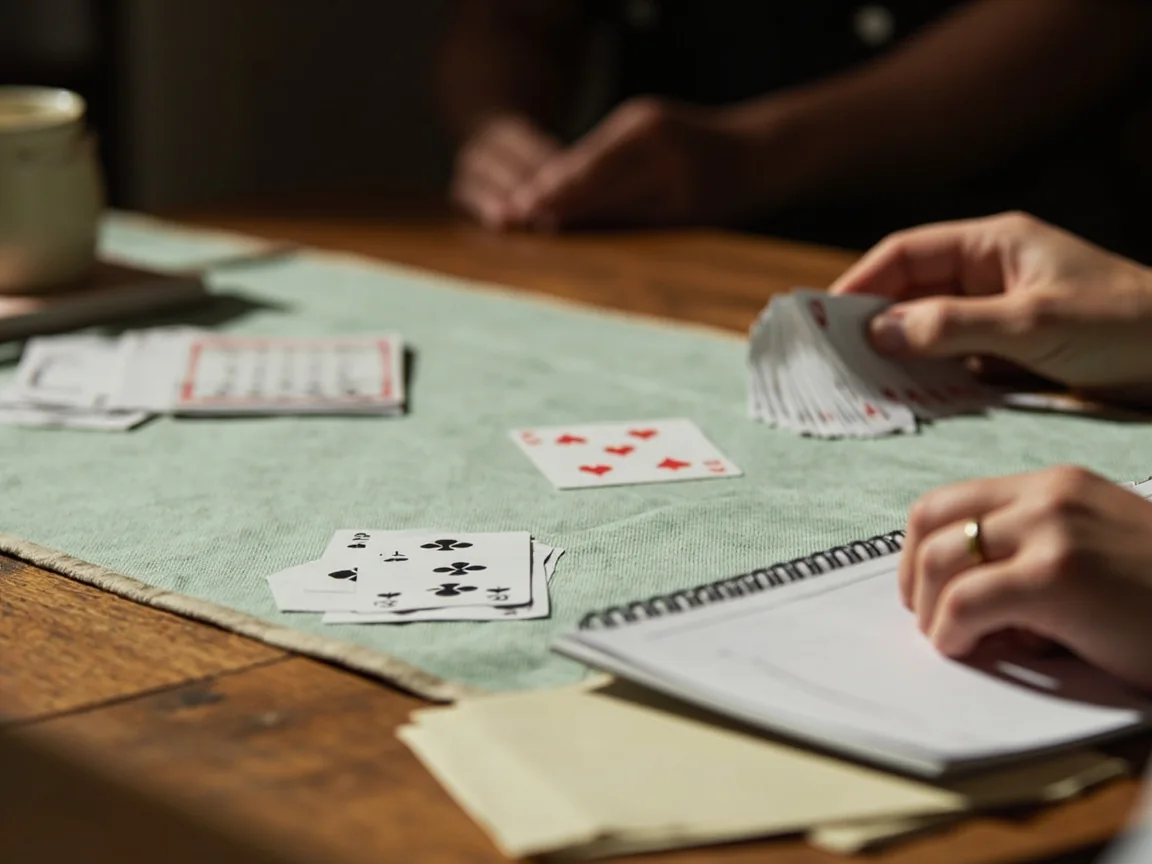
Step 02 · Drawing
Each turn begins with one draw.
A turn starts with the player either picking the top face-down card from the stock or taking the top card of the discard pile. If you take from the discard pile and then lay it into a meld on the same turn, the move is "showing" — and it gives away your pattern. If you take from the discard and do not meld, you have wasted a read.
When to take from the discard
Take from the discard when the card you would lift completes a sequence or set you were already half-built. Take from the stock otherwise. A common disciplined choice is to default to the stock and treat the discard as a tactical pivot.
Step 03 · Melding
Lay down a valid grouping; first meld should be a pure sequence.
Once you have drawn a card you may lay down any combination of pure sequences, impure sequences and sets that you can complete with the cards in your hand. There is no minimum meld size in many Indian formats; the constraint is the pure-sequence-first rule at declaration.

The discipline of waiting
Holding off on melding keeps your pattern private until the last plausible turn. The cost of revealing your hand early is more than the cost of a slightly later declaration; an opponent who has seen three of your groupings will compute your deadwood within a turn or two.
Step 04 · Discarding
Close the turn with one card on the pile.
Each turn ends with exactly one card discarded face-up beside the discard pile. Choosing that card is the most readable decision a rummy player makes all evening. The cost of the wrong discard is rarely the card value; the cost is the information you give the table about your hand.
What to discard
- A high-value card you cannot group (J, Q, K, A, 10 in any suit).
- A wild-joker copy once your sequences are complete and the joker is no longer needed.
- A printed joker — zero points, never useful as a value card, easily replaced from stock.
What to avoid discarding
- Cards that complete an opponent's likely sequence (a 7 when two 8s are on the pile, for example).
- The fourth card of a suit if the table has not seen two of that suit already.
- A card that you would draw back the next turn — the discard pile is not a temporary holding bay.
Step 05 · Showing and declaring
When all thirteen cards are grouped, announce and verify.
A declaration is announced by laying the final picked-up card face-down and pushing the whole hand toward the centre. The table verifies each grouping. A valid declaration needs at least one pure sequence plus any combination of impure sequences and sets to cover the remaining cards.
Validation checks
- At least one pure sequence of three or more same-suit consecutive cards.
- Total grouped cards equal thirteen.
- No illegal use of wild jokers (e.g. a pure sequence that secretly uses one).
- The final card declared is consistent with the discarded card pattern.
If any check fails, the hand is treated as a wrong show. The wrong-show penalty is the table's maximum deadwood score (commonly 80 points) and is charged to the declaring player.
Common mistakes
Six errors readers can avoid by reading them once.
| Mistake | What happens | Prevention |
|---|---|---|
| Declaring without a pure sequence | Maximum deadwood penalty | Always confirm a pure sequence of three same-suit, consecutive cards before declaring |
| Wrong-show penalty | Maximum deadwood penalty | Have the table verify the grouping before you formally declare |
| Forgetting the wild joker convention | An impure sequence fails at declaration | Read the rule sheet at the start of every session |
| Meld-revealing too early | Opponents compute your deadwood | Delay the first meld until the pattern is committed |
| Discarding a useful card | A opponent completes a sequence on the next turn | Track by suit and rank across the visible discards |
| Dropping a promising hand too early | You pay the drop penalty without testing the pattern | Drop only after the second draw has not produced a usable meld |
Quick glossary
Common terms in plain English.
Pure sequence (शुद्ध अनुक्रम)
Three or more consecutive cards of the same suit, no wild joker in the chain. Required for a valid declaration.
Impure sequence
Three or more consecutive cards in which one slot is filled by the wild joker or printed joker.
Set
Three or four cards of the same rank in different suits.
Wild joker
All cards of the rank shown in the flipped card at the start of the deal.
Printed joker
The joker card in the deck; counts as zero points and can substitute for any other card.
First drop
Leaving the hand before picking up any card from stock. Cheapest drop penalty.
Middle drop
Leaving after picking at least one card from stock but before melding. Heavier penalty.
Wrong show
Declarations with invalid groupings or extra cards carry the table's maximum deadwood penalty.
Continue with strategy.
Reading the rules is the foundation; reasoning about the table is the layer on top. Move to strategy boundaries.
Table etiquette
Behavioural conventions at a real-money rummy table.
- Signal intent, not information. A take-from-discard should complete a meld in the same turn; otherwise it leaks a sequence the table cannot complete without you.
- Do not chat about hands in progress. Any chat about the running hand can be construed as collusion; most operators treat it as a strict-liability offence.
- Declare cleanly. Push your cards, state "declare", and let the table verify. Avoid mid-declaration commentary.
- A drop is a drop. A player who signals a drop has paid the drop penalty; the table continues without comment.